We’re All Americans, Dammit

I’VE SAID THIS BEFORE, BUT it’s more important now than ever:

“I pledge allegiance to the Constitution
Of the United States of America
And to the ideal on which it stands:
One nation of individuals
Indivisibly intertwined
With liberty, justice, and peace for all.”

(So help me, G?d. And so help all of us.)

Minute Mitzvah: ALL ONE ALL ONE OK OK!!!

Today’s Task: Know that “God” is One.

My dead psychic twin Sputnik, who rediscovered his natal Christian faith around the same time I came back to Judaism, was fond of saying, “Monotheism is not for wimps.” By that he meant that if you subscribe to the nondual one-Source-for-everything paradigm, you have to take the bad with the good: earthquakes and aurorae, wars and wonderment, convicted felons and patriots. In other words, if you believe that “God” is only responsible for the stuff you like, and is not to be found in the stuff you don’t, you might be spiritually hobbling yourself. Since the potential for every particle of existence emerged from the Big Bang, we are ALL connected; even to the people and things we despise. That can be a hard concept to swallow — but it can also be worth the chew.

Exercise: Flex those soul-jaws by trying to digest the idea that someone or something you find objectionable, or even loathsome, also partakes of the Divine. That doesn’t mean you have to condone or agree with them or it – an important distinction! – only that you acknowledge the connection. (Or, as Robert Anton Wilson writes, “Everyone has the Buddha-nature, but some poor bastards just don’t realize it yet.”)

365 Names of God: “The One Who Spoke and the World Came Into Being”

THE ONE WHO SPOKE AND THE WORLD CAME INTO BEING expresses a pretty profound metaphor, at least to those students of the Torah unbothered by anthropomorphism. Think about the many possible ways to spin a creation myth: divine entities dreaming everything into existence; a landscape composed of a giant dragon’s hero-dismembered parts; a war of cosmic proportions between co-creators; divine entities populating their fresh new world with grateful worshippers just for amusement. But the Torah’s version is sublimely, psychologically subtle: it posits that our reality is created by words. And really – isn’t it?

Once upon a time, in 2011 in fact, The Metaphorager aspired to daily feature a year’s worth of different names for that-which-some-people-call-God: some creative, others traditional, each unique. For reasons, instead we’re going to occasionally post one until we run out of what we’ve collected so far. If you want to see your favorite here, but haven’t, pass it this way with the subject line “365 Names” and let us know whether or not you want to be credited.

Pocket Theology

BEFORE WE BEGIN, LET’S HAVE an agreed-upon definition or two (c. OED, mostly):

mystic 1. one who believes that union with or absorption into the Deity or the Absolute, or the spiritual apprehension of knowledge inaccessible to the intellect, may be attained through contemplation and self-surrender. 2. one possessed by self-delusion or dreamy confusion of thought, especially when based on the assumption of occult qualities or mysterious agencies.

Strange words? Confusing? Off-putting, even? Granted. However:

skeptic an ancient or modern philosopher who denies the possibility of knowledge, or even rational belief, in some sphere.

Ethnically and religiously, I consider myself a Jew through and through (for some values of the word “Jew”). And as one who self-describes as mystic #1, it seems to me that “religion” is to “mysticism” as “cheering a team” is to “playing the sport.” Not content with worshipping the Divine, what I really want is to thoroughly and joyfully wallow around in It.

At the same time, experience has taught me to be leery of those self-proclaimed “mystics” who fit definition #2. That’s where skepticism can be handy; as noted elsewhere, I am wordlessly convinced of an indefinable, infinite, yet universal sentience laced through and underlying all existence. But human knowledge is only finite, and human certitude – even or especially the gut-level, immediate, intuitive variety – can be illusory and deceptive. So I also embrace the possibility that I could be completely wrong.

And I’m okay with that.

Given the universe’s detailed complexity, comfort with ambiguity is an important, even essential quality of any spiritual discipline. (As my friend Sputnik liked to interject during enthusiastic theological explanations, “Sounds about as good as any other damn thing.”) We cannot become so convinced of our own Inner Truth that we become dogmatic about it, especially at the expense of others. That way lies fanaticism, cultishness, and the darkest sort of militant, lock-brained fundamentalism.

To paraphrase Ivan Stang, another favorite philosopher: “‘God’ is not a fan club.” So join me on that field – and let’s play our hearts out.

Points of Honor, Literary and Otherwise

– STUFFING SENTENCES TO CARRYING CAPACITY.
– Never starting a blog post (or sermon) with “I.”
– Punctuality.
– Creative segues.
– Repeating verbatim whatever someone wants said to another.
– That only what I actually heard appears inside quotation marks.
– One-sentence ledes.
Snappy ledes. (“If you can do that, you’ll never be out of a job,” quoth a mentor.)
– Keeping an open mind, especially when it’s difficult.
– Never speaking in absolutes. (Present list excluded.)
– Crediting my sources.
– Communicating as accurately as I can. (Challenging, but aspirational.)
– Pushing through my shyness. (Also aspirationally challenging.)
– Being kind to cashiers, sales clerks, waiters, and tradesfolk.
– Saying “Take your time” whenever necessary.
– Waving at passing cars.
– Not speculating.
– “Killing my darlings” (per Wm. Faulkner, via Stephen King).
– Making an effort to pet stray cats.
– Greeting passersby with (at least) a smile.
– Concisifying.

(And yours?)

A Short Course in Flabbergastery

IN HIS EPIC, THREE-VOLUME Burnham’s Celestial Handbook, the astronomer Robert Burnham, Jr., proposes the following metric:

Let one astronomical unit (the mean Earth-Sun distance) equal one inch. On that same scale, one light-year, or 63,360 astronomical units, equals one mile; in our model, that puts Alpha Centauri, our closest stellar neighbor, just over four miles away.

See how big space is? But let’s go further.

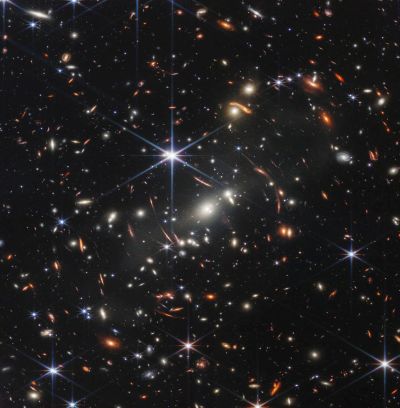
Fig. 1.

In October 2022, the James Webb Space Telescope peered 13.1 billion light-years into one tiny slice of our all-surrounding nothingness (see Fig. 1). On Burnham’s scale, that’s 78,067,190,880,000,000,000,000 miles — or roughly the distance from Earth to just beyond the boundary of interstellar space.

And if your mind is still insufficiently blown, think on this: Except for a handful of relatively close six-rayed stars, the smudges of light you see in Fig. 1 are all galaxies.

GALAXIES. Each containing hundreds of billions of stars, a good many of which are just like our Sun.

Wow. Right?

Contemplating such vasty depths may challenge our sanity. But I also think such a meditation is good for the perspective.

Because in all that unending emptiness, there is only one of each of us: unique, ephemeral, irreplaceable. Enjoy yourself if and while you can — and don’t forget to floss.

Here’s What I Know …

… AND WHEN I SAY “KNOW,” I’m not talking about “faith,” “opinion,” or “reasoned analysis,” but an intimate, visceral, experiential knowing. (Torah has a word for it — דַעַת — “da’at,” which can also refer to intimacy of the sexual variety.) So here’s what I know, in the same wordless way I know that I’m sitting at a desk typing these words to you:

1. The Universe is sentient.

2. This sentience cannot be fully described in words, including these.

3. This sentience can be directly apprehended.

4. Given this sentience’s unitary nature — as well as that every atom everywhere emerged from the Big Bang — all divisions are illusory, solely arising from the all-encompassing immediacy of our own ego-experience.

And that’s all I know. (And of course, I could be wrong.)

Any questions?

Favicon Plugin created by Jake Ruston's Wordpress Plugins - Powered by Briefcases and r4 ds card.