KING A translation of the Hebrew word “melech” (מלך), this Name has fallen out of favor in Liberal Judaism circles due to two factors: 1) It’s male-gendered, and thus anthro/patriomorphic (and conceptually inaccurate); and 2) as people who live in a democratic republic, we’ve lost touch of what being a king entails: his word is law, he submits to no one, and he wields the power of life and death over his subjects. Since the word “melech” is present in all classical Jewish blessings and in many prayers, some Liberal siddurim (prayerbooks) substitute “Sovereign,” others “Source.” As my first philosophy professor was wont to say, “You pays your money, you takes your choice.” Continue reading “365 Names of God: King”
Tag: WIP
Works In Progress. The “typing” part of Writing — and the most challenging.
Words to Bring Back: “Desuetude”
– Definition: n.; pronounced “DES-wuh-tude” or “de-SUE-uh-tude.” A condition of disuse.
– Used in a sentence: Unless we act to protect them, our Constitutionally guaranteed rights are apt to fall into desuetude.
– Why: It rolls nicely off the tongue. Besides, who actually says “disuse?”
Why I Love: Sonoma
 IT’S THE HISTORY. IT’S THE diversity of food, from restaurants to markets to semipermanent food-trucks. It’s the out-of-state license plates ringing the Plaza on weekends. It’s the eight-acre Sonoma Plaza itself: families having picnics, occasional Tai Chi enthusiasts or Morris dancers, the rose garden(s), the three fountains, the bridge over the duck pond, the ducks, the former chickens, the sundial, even the smelly gingko tree. Continue reading “Why I Love: Sonoma”
5 Thoughts: The REAL First Fandom
 1. WHAT IF WE LOOKED AT Torah as if it were another created world, a la the works of Tolkien, Roddenberry, or Lucas? and its adherents as members of (perhaps) humanity’s oldest text-based fandom?
2. For one thing, they already bear a strong resemblance. Consider “midrash,” from the Hebrew word meaning “to study” or “interpret.” Midrashim are rabbinic stories addressing behind-the-scenes bits of Torah that aren’t explicit in the text: why did Abraham become a monotheist? Who was the first person to cross the Red Sea? Why are there two creation stories in the book of Genesis? Continue reading “5 Thoughts: The REAL First Fandom”
365 Names: Tao
TAO Coined in the Tao Teh Ching by Chinese sage Lao Tzu c. 7th century BCE, this Name is best known from the book’s opening line, “The Tao that can be told is not the eternal Tao.” (In other words, if you can name It, then what you’ve named isn’t It.) I like it because it accents the inherent unknowability of that-which-some-people-call-G?d. Slight drawback: Lao Tzu wasn’t a Deist; i. e., his vision of TWSPCG wasn’t of a conscious Being so much as a natural force. Still, I’ve put it here both for completeness’ sake as well as that it’s one of the cornerstones of my personal theology. YMMV. Continue reading “365 Names: Tao”
First Graf: The Gourmet’s Lexicon
 SITTING ON MY BOOKSHELF IS a slim purple volume from 1982 called The Gourmet’s Lexicon, an encyclopedic and indispensable listing of cuisines, dishes, and cooking techniques and styles. What Webster was to words, author Norman Kolpas is to food. Often I will leaf through it at random, trying to expand my cookery-consciousness; other times I will use it to look up something I see mentioned in a recipe or on a cooking documentary. (I’ve even used it as a basis for a few Prosatio Silban tales.) Whatever the need or occasion, it’s a fine ingredient in any cook’s or foodie’s library. Continue reading “First Graf: The Gourmet’s Lexicon”
Words To Bring Back: “Terrible”
– Definition: adj. Of a nature to excite terror; appaling
– Used in a sentence: “That’s the most terrible Hallowe’en costume I’ve ever seen.”
– Why: The current connotation of “terrible” as slipshod, sub-par, etc. really grinds my gears. Time to get back to roots and enjoy it as Webster and Funk & Wagnalls intended.
365 Names: Providence
PROVIDENCE literally means “that which/one Who provides.” It’s a comfortable and comforting image: G?d as Supplier of Necessities. For some reason, it pops up a lot in 18th- and 19th-Century literature and life, including as a proper name. Perhaps it’s an Industrial Age thing. Continue reading “365 Names: Providence”
First Graf: The Jewish Catalog

As the subtitle implies, the book is chock-full of homemade ways to “do Jewish,” from making your own challah, tying and laying tefillin, navigating a siddur (prayerbook) or the Torah, burying someone with dignity, mystically understanding Shabbat, navigating the “Jewish Establishment” and much much more. Published in 1973 (and serially reprinted since then), it spoke to the nascent anti-authoritarian paradigm of “ethnic pride” and “finding your roots” that was then sweeping the United States. It features articles from such luminaries as Rabbi Zalman Schachter (founder of the Jewish Renewal movement) to Holocaust scholar Deborah Lipstadt, and sparked a communal yearning for authenticity and connectedness that still resonates today. The lavishly illustrated book spawned two sequels and is still relevant to anyone seeking to jump into the sea of Judaism: Continue reading “First Graf: The Jewish Catalog”
Words to Bring Back: “Artless”
– Definition: adj. 1. Lacking craft or deceit; guileless; naive. 2. Natural; simple
– Used in a sentence: Her whole manner, from clothes to attitude, was perfectly artless.
– Why: A useful antidote to the snarky, cynical-chic times in which we live; the world might well be a happier place for its actualization.
First Graf(s): The Book of the SubGenius
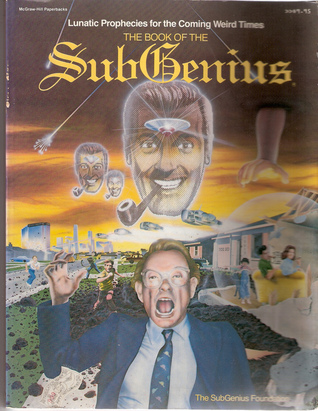 THIS BOOK SAVED MY LIFE. Well, not the book per se — although that definitely helped — but one of the guys who wrote it. The Book of the SubGenius told me that there were Others Out There who felt and thought as I did (or as differently as I did), and when I went through a suicidal phase back in ’85 I wrote to co-author Ivan Stang explaining my position. He immediately wrote back a two-page letter asking me not to do it and saying that if nothing else, I could always live for spite — that living could be a sort of revenge against the multiform factors contributing to my wanting to off myself.
Dang if he wasn’t right. Continue reading “First Graf(s): The Book of the SubGenius”
365 Names of God: Design Group
DESIGN GROUP A friend of Ann’s brought us this term, which was then current among her friend’s med-school colleagues. While I believe that scientists shouldn’t budge an inch from their pursuit of Truth, this Name can be a great way for biology teachers to ride the line between Darwin and religious fundamentalism in places where the latter holds the dominant paradigm. (Even works if folks take Genesis 1:26 literally.) A strictly secular Design Group would count as its elements such diverse “personalities” as DNA, liquid water, gametes, natural selection, deep time, et al. Continue reading “365 Names of God: Design Group”