 INTERVIEWING ONE’S CULTURAL HEROES IS one of the greatest thrills of a career in journalism — even of amateur journalism. Such was the position in which I found myself while working for Obscure Research Labs in the early-to-mid-1990s. It gave me an insider’s excuse to pester thinker and novelist Robert Anton Wilson, and granted equal access to Church of the SubGenius co-founder Ivan Stang. Herewith this interview, conducted through the mail and slightly edited for clarity and length, which first appeared in Far Corner v1n7, c. 1993. Kick back, slack off and enjoy this longest-by-far of The Metaphorager’s 800+ posts. Continue reading “ORL Interview: Ivan Stang”
Tag: ORL
An affiliate of the /real/ MIBCO.
Why I Love: Robert Anton Wilson
 IT’S THE WAY HE BLOWS my mind. It’s the way he mixes conviction with doubt. It’s his searingly funny prose. It’s his search for Ultimate Relativity. It’s that he taught me some important Latin phrases, like “Cui bono?” and “Non illegitimati carborundum” (look ’em up). It’s how he manages to make everything he writes sound like a personal communication to the reader. It’s the little phrase-gems he drops off-handedly like “reality-tunnel,” “domesticated primates,” or “guerrilla ontology.” It’s his nimble skipping from neuroscience to neuropoetry to neuroanalysis to neuropolitics. (It’s also that “neuro-” is his favorite prefix.) Continue reading “Why I Love: Robert Anton Wilson”
5 Thoughts: The ORIGINAL Matrix
 1. WHILE I DON’T BEGRUDGE THE siblings Wachowski their success, and I don’t really believe they stole my idea, as the first populizer of something called “The Matrix” I feel I must firmly and finally speak my piece.
2. Make a circle with a dot in the center. The dot represents you. Within the circle is the sum of your knowledge. Outside the circle is the vasty unknown. The circle itself? I call that The Matrix.
3. This simple reality-diagram was created by me c. 1990, long before the first installment of the popular film series, as part of the work I did for Obscure Research Labs. Continue reading “5 Thoughts: The ORIGINAL Matrix”
First Graf: Fringes of Reason
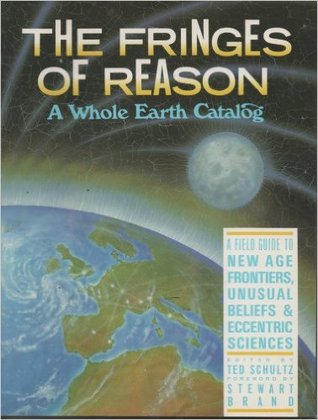 REMEMBER THE WHOLE EARTH CATALOGS? Mostly subtitled “Access to Tools,” they were popular mainstays of the late 1960s-1970s’ DIY culture, spanning a variety of subjects from computers to home gardens. One of them, 1989’s Fringes of Reason: A Field Guide to New Age Frontiers, Unusual Beliefs and Eccentric Sciences, deserves a place on the bookshelf of any student of the more outre reaches of the human condition, right along with Charles Mackay’s Extraordinary Popular Delusions and the Madness of Crowds or The Books of Charles Fort (both of which are covered in detail — as is The Book of the SubGenius). Continue reading “First Graf: Fringes of Reason”
Live Long and Proffer
 THE FIRST SOLO BAY AREA excursion I made after my mom and I moved to Walnut Creek in August 1977 was a trip to the aptly named Federation Trading Post, a Berkeley specialty store selling all sorts of Star Trek merchandise.
It was my second brush with official fandom of any sort. When I still lived back East, I had attended the 1975 Boston Star Trek convention, where my 13-year-old mind was blown by a hotel full of people who all suffered from the same obsession I did. Oh, I had it bad. Continue reading “Live Long and Proffer”
First Graf(s): The Book of the Damned
!
,.
— –. ? ,;.
? — http://languageremoval.com/.
Ghosts Don’t Interest Me
NOTE THE SPECIFICITY OF THE title — I didn’t say I don’t like ghosts, or that I shun their company or “disbelieve” in their “existence.” But they’re no big thing to me, any more so than the other amazing things about which I can do nothing but appreciate.
Like most people, I stand at the rim and center of diverse circles of friends: the local Jewish community, the local media community, my pirate buddies, college fiends, pagans, ol’ hippies and any number of peace officers, firefighters and clergyfolk, each of exceptional intelligence and veracity, all of whom trust their eyes and ears despite preconceptions, and whose only motivation in retelling some awfully weird goings-on was to understand their UFO sighting, religious vision, haunting, reincarnation evidence, Ouija session, telekinesis, missing time, seance, monster encounter or near-death experience. (Like I would know.) Continue reading “Ghosts Don’t Interest Me”
From the Ashes
AS DETAILED ELSEWHERE, I DID some freelance work in the early 1990s for an eccentric Northern California non-profit called Obscure Research Labs.
Well… when the phone rings at 3 a.m. and the familiar metallic voice offers an occasional work-from-home project featuring fabulous prizes, free virtual travel and a steady below-poverty income, all I could say was https://metaphorager.net/orl: ORL’s new Facebook page. And I’m told that if enough people “like” it, They might even throw in some food chips. True, it’s a long way to the surface from this new office, but They assure me the packaging will prevent most breakage…
6,855,687,281 Minus 9
THAT’S THE NUMBER OF PEOPLE currently inhabiting the Earth’s surface (according to http://www.census.gov/main/www/popclock.html at 19:11 UTC, July 13, 2010), less the nine currently orbiting it (according to http://www.howmanypeopleareinspacerightnow.com/).
(Data maketh strange bedfellows. But at least we know how many.)
ORL Interview: Robert Anton Wilson
(AS A FOLO TO THE previous post, and at the urging of sinister forces who would prefer I remain nameless, I now present a reprint from the bygone Bulletin of Obscure Research, Far Corner (v1n5, c. 1991): an interview with the late Robert Anton Wilson, who wrote about everything Dan Brown does (and much, MUCH more) but did it first and funnier. He was and is a great influence on both my writing and my thought, and I hope his fans will be amused rather than disappointed by this previously Lost Interview (conducted through the mail and transcribed with errors intact rather than scanned, at least for now). And if you’re listening, Bob — thanks for the cartography lessons.) Continue reading “ORL Interview: Robert Anton Wilson”
ORL History, or Where’s Mine?
LONGTIME READERS WILL PRICK THEIR pointed ears at the mention of “Obscure Research Labs.” If you’re not one of them, but especially if you are, please read on:
Back around 1989 or so, I became involved with a group billing itself as “the world’s only TRUE research organization … devoted to finding out Just What’s Going On” (see FAQ). Headed by BT Elder, whose tenure as Professor of Applied Memetics at Miskatonic University came to an abrupt and scandal-hushed end during the 1970s, Obscure Research Labs played a key role in the development of 1990s-era underground popular culture. Without ORL’s influence, Roswell would still be a noncommittal speck on the Nevada map; the Men in Black (the real ones, not their sequel-laden counterparts) would still be frightening witnesses with anonymous abandon; and the Wachowski brothers would still be stuck for an Idea.[1]
The scope of ORL’s work and accomplishments would require several volumes to explain in disambiguating detail. Suffice to say, despite the hours and working conditions I accepted the position of newsletter editor and produced seven issues of the ORL bulletin, “Far Corner.” Filled mostly with recent ORL doings, specifically in the areas of time travel and experimental mass psychology, the newsletter also featured interviews with such secretly famous celebrities as Robert Anton Wilson and Ivan Stang.
Of course, that was all before ORL’s still-unexplained disappearance c. 2002. Although I haven’t worked for them in years, I still Google them on occasion to see what they’re up to, if at all (also, they still owe me money). Thus, imagine my surprise when I discovered someone selling ORL merchandise at inflated prices! It is flattering to have produced a collectors’ item, but annoying to be cut out of the profits. At this writing, I have been unsuccessful in contacting the seller — for all I know, he or she or it may be a disgruntled ex-employee (of which ORL seemed to produce dozens, all altered in some fashion) trying to recoup his, her or its losses.
But perhaps it’s better not to know; to let, as it were, tricephalic dogs lie. After all, according to ORL’s credo and operating principle, “You never can tell…”
[1] Few are aware that “the Matrix” is the name given by Elder and his mentor, Neal Higgins, to the “glue” which binds consensual reality like the dough in raisin bread: “Among other things, The Matrix is the theoretical basis for just about everything we do here at ORL. Put simply, it’s that vast area between what you know and what you don’t; paradoxically, it’s both universal and personal. (If you could make a circle around yourself to illustrate the limits of your perception, the area inside would represent your knowledge. Outside lies your ignorance. The circle itself is the Matrix — the indeterminate state you use to account for the existence of things you can’t see but ‘know’ are there, like the person typing these words.)” — from the ORL FAQ