 IT’S THE BLUE INTERTITLE PROCLAIMING “A long time ago in a galaxy far, far away…” It’s the concept of the Force: nakedly nondual, essentially Taoist, but not preachy about it. It’s the costumes. It’s the sets (even the CGI ones, but especially those of handmade origin). It’s the original spaceship designs. It’s the lightsaber battles, especially the long-awaited-by-fans Darth Vader v. Obi-wan Kenobi duel in Episode III. It’s the way each film ups the special-effects ante for the whole film industry. It’s the details. It’s the recycled sounds; especially for R2D2, the jawas, various droids, etc. (It’s also the Wilhelm Scream.) Continue reading “Why I Love: Star Wars”
Tag: WIP
Works In Progress. The “typing” part of Writing — and the most challenging.
365 Names of God: Goddess
GODDESS IS USUALLY THE NAME invoked by people who see the word “God” — and especially Its biblical avatar — as male-gendered and wrathful. “Goddess” is sometimes also characterized as the Nurturer, the Comforter, the Creatrix, the Great Mother; the One in whom one can find solace, inspiration and joy. (It should also be mentioned that Wiccans and neo-pagans often posit both a God and a Goddess to describe what they see as an essentially binary universe, and one that they feel is ill-served by only one deity.) For those seeking a friendlier, gentler god-concept, though, Goddess is hard to beat. Just don’t make Her mad. Continue reading “365 Names of God: Goddess”
Words To Bring Back: “Proffer”
– Definition: v. t. To offer for acceptance.
– Used in a sentence:To you the reader, I hereby and humbly proffer my Cook For Any Price stories.
– Why: It implies a social contract somewhat different from its rhyming synonym; I think of it as a kinder, genteeler sort of offer.
365 Names of God: “The Divine”
THE DIVINE This Name tends to be used in circles where the word “God” might cause people discomfort for one reason or another. I’ve mostly seen it in New Age contexts as a non-anthropomorphic gambit to refer to an intentionless force similar to Tao, and have used it myself if I think my co-conversationalist has bad associations with “God.” But I long for a world where “God” can automatically mean “that-which-some-people-call-God,” with no dangerous baggage. (Open your suitcase, please.)
Words To Bring Back: “Cubit”
– Definition: n. A unit of measurement; the distance between one’s elbow and middle-fingertip (approximately 18 inches)
– Used in a sentence: My cat is almost exactly two cubits long, including his tail.
– Why: Sure, we could always double the distance and call it “a yard” — but cubit is more organic, deriving as it does from our bodies. And I think measuring the Universe using our bodies is both a good metaphor and a fine aspiration.
365 Names of God: “The Mystery”
THE MYSTERY is what I decided in 2010 to use instead of the word “God,” since it then encapsulated everything-I-knew-I-didn’t-know-about-G?d (including why I spell it with a question mark). It’s just too big, you know? And mysterious. And incomprehensible. And opaque to understanding. And paradoxical. And … and … and … well, you get the idea. (Or should that be “Idea?”) Continue reading “365 Names of God: “The Mystery””
Why I Love: Travel
IT’S THE NOVELTY. IT”S TRYING to see new places through the eyes of their long-time residents. It’s the road-trip soundtrack, whether CDs, tapes or new-to-me radio stations. If flying, it’s seeing the landscape from a different perspective; it’s the tiny bottles; it’s the in-flight magazines and audio offerings (and it was eating the twice-wrapped kosher meal, at least when airlines still offered meals). It’s watching urban areas dissolve into countryside the further away you get from the city. It’s finding new places to eat, and eating like the locals. It’s testing the limits of my comfort zone. It’s the packing. (It’s also the unpacking.) Continue reading “Why I Love: Travel”
Words To Bring Back, Special Edition: “Wheeler”

– Definition: v. To unconsciously, persistently and innocently pocket other people’s stuff. Continue reading “Words To Bring Back, Special Edition: “Wheeler””
365 Names of God: Not-Two
NOT-TWO One of our living-room Torah participants laid this Name on me a while ago. As a fierce non-dualist myself (meaning that I see the Universe as one whole Being rather than an assembly of parts), I instantly took to it. She explained that it differs somewhat from the idea of “attaining” Oneness in that it encourages such unification from the position of apparent duality; “not-two” starts from where the perceiver begins — the “universe of ‘the,'” or apparent separation — rather than where he or she wants to wind up (and in fact actually “is” all along). Our correspondent added that she got it from one or more Buddhist teachers, although at this remove I don’t remember who said it or what sect they were from. Use it in good health. Continue reading “365 Names of God: Not-Two”
First Graf: Fringes of Reason
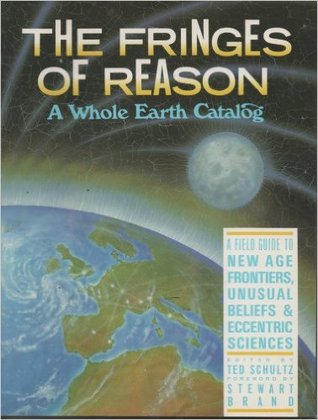 REMEMBER THE WHOLE EARTH CATALOGS? Mostly subtitled “Access to Tools,” they were popular mainstays of the late 1960s-1970s’ DIY culture, spanning a variety of subjects from computers to home gardens. One of them, 1989’s Fringes of Reason: A Field Guide to New Age Frontiers, Unusual Beliefs and Eccentric Sciences, deserves a place on the bookshelf of any student of the more outre reaches of the human condition, right along with Charles Mackay’s Extraordinary Popular Delusions and the Madness of Crowds or The Books of Charles Fort (both of which are covered in detail — as is The Book of the SubGenius). Continue reading “First Graf: Fringes of Reason”
Words to Bring Back: “Ambit”
– Definition: n. A space surrounding a house, castle, town, etc. A precinct.
– Used in a sentence: It is my ambition to diligently guard my ambit against encroachment.
– Why: Where I live in semi-rural Northern California, such things are known as “open space,” “green space” or “urban growth boundaries” and are considered sacrosanct against development. But “ambit,” being more compact, sounds like something to strive for rather than something attained.And isn’t the journey always better than the destination?
Why I Love: Torah Study
IT’S THE ENDLESS INTELLECTUAL PUZZLE. It’s that Hebrew writing closely resembles Klingonese (well, it does; come to think of it, so does some of the sentiment). It’s belonging to the 3,000-year-old Permanent Floating Book Club. It’s the spectra, vagaries and levels of meaning. It’s the idea of “seventy faces of Torah,” meaning that each word (even letter!) can be looked at in multiple ways. It’s engaging with the minds of long-dead people who live on in your study. It’s the level playing field (“Only a little is all anyone knows of Torah,” quoth the greybeard rabbi). It’s seeing how far the Sages can stretch a metaphor. Continue reading “Why I Love: Torah Study”