I AM A FANTASY WRITER; that is to say, I fantasize about people reading my writings.”
–Your author, in a truth-pensive mood
Tag: reading
The whole and entire purpose for Writing (outside of its own).
5 Thoughts: Seminal v. Derivative
1. ONE OF THE CHICKEN-OR-egg challenges of modern media (social and traditional) is their pervasive sense of nonlinear immediacy, by which I mean the everything-at-once flattening of the artistic landscape.
Continue reading “5 Thoughts: Seminal v. Derivative”
Elevator Pitch: The Cook For Any Price
“A SELF-DEFROCKED HOLYMAN WANDERS A fantastic landscape, eking out a meager but honest living as a mercenary cook.”
“…And Just Exactly What Is A ‘Buopoth?'”
“MUCH HAS BEEN WRITTEN ABOUT the quaint and lumbering buopoths native to the Exilic Lands and other curious places – but to this day, little remains understood about the shy beasts beyond the proverb that ‘they will haul all day on a fatberry-cake and a kind word.'” — from Road Bound
That’s the in-universe explanation from one of my Prosatio Silban stories. Outside the stories, it’s a different matter entirely…
According to H.P. Lovecraft‘s 1927 novella The Dream-Quest of Unknown Kadath (a ripping good read if you’re so inclined):
In former dreams he had seen quaint lumbering buopoths come shyly out of that wood to drink, but now he could not glimpse any.
First Graf: The Dharma Bums
IN MANY WAYS, THIS 1958 book is better than the earlier On the Road. Kerouac’s signature stream-of-consciousness narrative style is more flowy, and the novel’s lionized centerperson (poet Gary Snyder, or “Japhy Ryder” as tDB calls him) a more noble character than OtR’s Neal Cassady — pardon me, “Dean Moriarty.” The Buddhism as portrayed is sympathetically casual without being didactic, which I suppose is also true of Buddhism itself. The book opens up in Los Angeles, where Kerouac (ahem, “Ray Smith”) is trying to “get the hell out of Dodge…” Continue reading “First Graf: The Dharma Bums”
Welcome to My World … Literally and Literarily
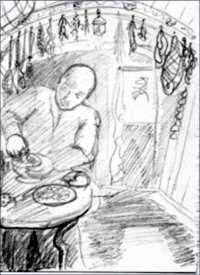
For many years now, I have been writing occasional fantasy tales about Prosatio Silban: a self-defrocked holyman turned mercenary cook in a far-off land containing a vast and disparate multitude of ancient and oft-commingled peoples, creatures, exiles, cultures, prophecies, landscapes, and cuisines. They vary in length from one-half to ten-and-a-half printed pages, with most ranging between three and five.
I enjoy writing them (“Do it for the buzz,” quoth Stephen King). I also enjoy having people read them. Thus, should the Universe so allow, I will here publish one every Thursday morning until further notice. (If you like what you read, you may also want the preface and introduction, as well as every story published up to now [plus ancillaries].) The subscription box at upper-left (or, if you’re on a tablet or phone, the box way below) will enable you to receive them via email as they become available. (Or, should you want 85 of them in one place (plus ancillaries!), may I suggest the e-book?)
Please enjoy. And if you’re so inclined — kindly spread the word.
First Graf (well, page): Harold and the Purple Crayon
THE FIRST BOOK I EVER read from cover to cover was Crockett Johnson’s 1955 work, Harold and the Purple Crayon. If you’re not familiar with it, it goes like this: A small boy in one-piece pajamas draws with, well, purple crayon, on an endless expanse of whitespace. His drawings don’t exactly come to life, but they do become interactively real (to him, anyway). The drawings are accompanied by spare but informative narration, but the real story is amply told by the charming illustrations. In all, Reb Crockett wrote seven Harold adventures; they are aimed at young would-be readers, and sort of obviate the whole Dick and Jane thing so popular when I was a tyke. Continue reading “First Graf (well, page): Harold and the Purple Crayon”
First Graf: The Histories
WERE IT NOT FOR HERODOTUS — lauded as the “Father of History,” derided as the “Father of Lies” — we would know nothing of, among other things, the tale of King Leonidas and the 300 Spartans and how it affected the Ascent of the West.
The Histories is more than a simple record of who-said-and-did-what-when. In it you will find plenty about the war between the Greeks and Persians, but also contemporary details of Egyptian and Babylonian culture; how to gather cinnamon despite the objections of giant bats “who shriek alarmingly and are very pugnacious;” an account of the horseback-warrior Scythians; many tales both tall and short; and much fodder for D&D campaigns or pleasant afternoon reveries. Continue reading “First Graf: The Histories“
It’s Really Spelled “Hallowe’en”
(TO BE CLEAR, IT’S ACTUALLY a slight abbreviation of the phrase “All Hallow’s Evening,” AKA “All Hallow’s Even,” AKA “Hallows E’en.”)
There’s something to be said about archaic or alternate spellings / renderings. For example, a beloved English teacher once opined that the spelling “grey” instead of “gray” made the word look and feel, well, “greyer.”
Different fonts make the words we read sound different in our minds. Italics (at least for me) convey a more choral mindfeel than does plain text; bold is like a quiet sit-up-and-pay-attention monotone; ALL CAPS evokes shouting; deletion lines are like mumbled static. Put them all together, and one has CONTROLLED CHAOS. Continue reading “It’s Really Spelled “Hallowe’en””
First Graf: The Adventures of Sherlock Holmes
ACTUALLY, SINCE T.A.o.S.H. IS THE first published collection of all Sherlock Holmes stories, here is (also) the First Graf of “A Scandal In Bohemia,” being the first of the tales in said collection. It’s unfortunate that Sherlock Holmes has become a bit of cultural cliche and byword, but it can’t be helped — our culture is steeped in such cliches, where what was once seminal now comes off as derivative. Sir Arthur Conan Doyle’s most famous creation, whom he eventually tired of and tried killing-off only to find that the clamorous 19th-Century reading “publick” would have none of it, stands on his own eternal literary measure. A little taste to whet the appetite, then? Continue reading “First Graf: The Adventures of Sherlock Holmes”
Why I Love: Robert Anton Wilson
 IT’S THE WAY HE BLOWS my mind. It’s the way he mixes conviction with doubt. It’s his searingly funny prose. It’s his search for Ultimate Relativity. It’s that he taught me some important Latin phrases, like “Cui bono?” and “Non illegitimati carborundum” (look ’em up). It’s how he manages to make everything he writes sound like a personal communication to the reader. It’s the little phrase-gems he drops off-handedly like “reality-tunnel,” “domesticated primates,” or “guerrilla ontology.” It’s his nimble skipping from neuroscience to neuropoetry to neuroanalysis to neuropolitics. (It’s also that “neuro-” is his favorite prefix.) Continue reading “Why I Love: Robert Anton Wilson”
First Graf(s): The Fellowship of the Ring
IF YOU HAVE ONLY SEEN the movie version of The Lord of the Rings trilogy, you are missing out on an extraordinary literary work.
Granted, it takes a while to get into — a criticism also (and often) leveled against authors Steven King, Herman Melville and other exposition-happy types. But you’ll be surprised by the richness of the prose, the wealth of Middle-Earth’s detail, and the extensive background material. It truly reads like an historical travelogue filled with interesting sights and people. (And you’ll also encounter some significant differences from the movies, chief among which being that Aragorn is not a wimp.) Continue reading “First Graf(s): The Fellowship of the Ring”