Q: “CAN YOU TEACH ME THE whole Torah in a dozen words or less?”
A: “‘Don’t be a jerk.’ The rest is details; now go experience them.”
Those Who Know, Chuckle.
I mean “wow.” Just … wow.
Q: “CAN YOU TEACH ME THE whole Torah in a dozen words or less?”
A: “‘Don’t be a jerk.’ The rest is details; now go experience them.”
OF THE 90% PETER JACKSON got right in his 11-hour and 22-minute adaptation of J.R.R. Tolkien’s best-beloved work – the lush landscapes, the Balrog, Elves, the Nazgul, Sauron, Orcs and Uruk-hai, Gollum, Ents, hobbits (MY GHAWD! THE HOBBITS!!!), the Ring, Grima, the very different cultures and props and sets and cities and overall “look” – he got right in abundance.
But that other 10% … oy.
Read the actual books and you’ll discover that Aragorn is not a timid wimp, Gimli is not comic relief, Arwen isn’t an avenging angel, Saruman and Gandalf never duked it out with magic staves, Faramir didn’t try to bring the Ring to his father, the dialogue is more formal and less modern (except for the rustic hobbits), there’s a wonderful character named Tom Bombadil, and the book features a single climax instead of three simultaneous ones. And that well-traveled literary road begins, quite simply, like this:
When Mr. Bilbo Baggins of Bag End announced that he would shortly be celebrating his eleventy-first birthday with a party of special magnificence, there was much talk and excitement in Hobbiton.
(If you’re not hot for stretchy, out-on-a-limb Jewish linguistic mysticism, best sit this one out. Otherwise, please enjoy.)
IT’S NO SECRET THAT JEWS love words. (After all, Torah begins with “God” speaking the world into being; if you need further convincing, check out almost any Jewish comedian.) Our tradition teaches that Torah contains no unintentional words nor letters – and that meaning can be extracted from it anywhere and everywhere you look. It’s all to play for, and we play hard.
Take, for example, the words “eved,” or “slave,” and “Ivri,” “Hebrew” – not the language, but a member of the tribe. Reading Fig. 1 and 2 from right to left, as one does in Hebrew, you’ll notice the third letter in each word looks very much alike: in eved, that letter is a dalet (D) and in Ivri it’s a reish (R). Another point is that the root word for Ivri is “eveir,” which means “to cross over.”


Now, stay with me here. It’s about to get weird.
Dalet is a 90-degree right angle, while reish is more of a sweeping curve. One way of understanding this difference may be that a slave is boxed in and constrained. A Hebrew, on the other hand, is a constraint-crosser: one who goes where the flow takes them in order to become more.
Mind you, this quality is not specific only to Jews, but to anyone who walks a way of self-transcendence. Jewish tradition teaches that anyone and everyone can practice growth – in skill sets, wisdom, spirituality, and character. But that osmotic, gut-level tradition is also one reason why there are so many Jewish doctors, scientists, philanthropists, Nobel Prize winners, and others devoted to improving the human condition.
And how exactly does one do that? See the last letter in Ivri? It’s a yod (Y), which symbolizes intuition and literally means “hand” – the appendage with which we effect change. Only good, hard, inspired and diligent work enables us to make a difference in this, the most interesting and problematic of all possible worlds.
Class dismissed.
Silence is the language of God. Everything else is a poor translation.”
— Rumi
– Definition: n That creation which evokes awe in the beholder.
– Used in a sentence: Have you ever heard Dr. King’s “I Have A Dream” wonderpiece in its entirety?
– Why: Though arguably a mere synonym for “art” (at least as defined by https://metaphorager.net/pithyism-5/), I like to think of this neologism as “art-PLUS.” Not all art stimulates our sense of wonder and reverence; not all oratory or music or cinema or poetry or what-have-you makes us weak-kneed with wordless appreciation. Yet we might be conceptually richer if we could point to what exemplifies art’s indefinable but very real power. Drop this word into your next deep conversation and see if it floats!
OPPOSABLE THUMBS ARE TO HANDS as language is to brains.
IT HAPPENED AS AN ALL-AT-ONCE thunderbolt moment that I wasn’t expecting, but it’s here and I can’t go back: I am now an enthusiastic and sincere convert.
Yes, it’s true. Despite my longtime denials and aspersions, the undeniable fact has overtaken me – and now, I fully, unreservedly, and happily love mayonnaise.
For years, I had a bad attitude when it came to the white stuff. “Slimy,” I called it. “Blandly WASPish,” I pooh-poohed. “That disgusting goo which defiles all that it touches,” I complained to anyone who would listen. It was in the house, yes, but used only by my copilot. I even avoided even touching the hefty glass jar with the familiar blue label, lest it somehow give me cooties.
But last month, curiosity (largely from watching Julia Child prepare her own from scratch) overcame aversion and I reached for That Condiment. I unscrewed the lid, scooped the tiniest bit on the tip of a teaspoon, brought it to my open lips, and licked experimentally.
WOW, I thought. Tangy. Salty. Rich. Flavorful. DELICIOUS! How could I have been so wrong for so long?
They say that if you try something and hate it, it’s because it wasn’t prepared properly. Mayonnaise preparation is simple: beat the dickens out of some eggs, then s-l-o-w-l-y add oil in a thin stream while you continue beating. Sprinkle a tot of mustard powder and a drizzle of vinegar (for stabilization, it’s said) and you’re prepared for feasting.
Since my conversion, I have been using it for a pre-breadcrumbing slather on Petrale sole, and as a binder in the best tuna salad I’ve ever eaten (along with anchovy paste, ground Dijon mustard, sweet relish, capers, black pepper, and a dash of thyme; an adapted recipe also courtesy of Julia Child) – and am eager for more.
So now, the question is: What are your favorite uses for this heavenly substance? Drop a comment in the space below!
LAUGH. SEE?”
— J.R. “Bob” Dobbs
IT DOESN’T REALLY MATTER WHERE or when I was, beyond that it was a high place from which I felt an overwhelming urge to jump.
I felt neither depressed nor sad nor suicidal. But I did feel scared, though mostly of the compulsion. In fact, I retained an echo of those feelings, not to mention utter perplexity, until happening across a healthline.com article which told me that such compulsions are very, very common. Normal, even.
It’s known as the “Call of the Void.” (In the original French, because the French have words for everything experientially interesting, “l’appel du vide.”) In clinical terms, it’s referred to as “High-Place Phenomenon,” and can also involve other aspects of self-harm: leaping in front of a train, steering one’s car into oncoming traffic, or sticking one’s hand into a garbage disposal. Naturally, these urges are quickly suppressed. And no one quite knows why we have such episodes – they may simply be an artifact of our neurological wiring – but it seems related to anxiety: the more anxious one is, the louder the Void calls.
We humans seem to be repelled by, yet attracted to, vast emptiness: the gulfs between stars and galaxies; abyssal ocean depths; wide-open deserts; untenanted warehouses; the view from a mountaintop. (BTW, the worst vertigo I ever experienced was while [very briefly!] standing on my head atop Northern California’s Mount Diablo – I literally felt as though I was dropping into the sky. Brrr.) Perhaps such things remind us of our insignificance. Perhaps we just don’t know what to do with (or in) them. Getting lost in immensity carries a deep discomfort; it blurs the lines we draw between Is and Is-Not. And that can be downright scary.
The most important thing to do when the Void calls? Don’t answer.
IN HIS EPIC, THREE-VOLUME Burnham’s Celestial Handbook, the astronomer Robert Burnham, Jr., proposes the following metric:
Let one astronomical unit (the mean Earth-Sun distance) equal one inch. On that same scale, one light-year, or 63,360 astronomical units, equals one mile; in our model, that puts Alpha Centauri, our closest stellar neighbor, just over four miles away.
See how big space is? But let’s go further.
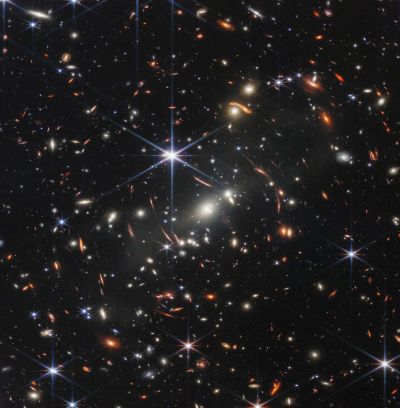
In October 2022, the James Webb Space Telescope peered 13.1 billion light-years into one tiny slice of our all-surrounding nothingness (see Fig. 1). On Burnham’s scale, that’s 78,067,190,880,000,000,000,000 miles — or roughly the distance from Earth to just beyond the boundary of interstellar space.
And if your mind is still insufficiently blown, think on this: Except for a handful of relatively close six-rayed stars, the smudges of light you see in Fig. 1 are all galaxies.
GALAXIES. Each containing hundreds of billions of stars, a good many of which are just like our Sun.
Wow. Right?
Contemplating such vasty depths may challenge our sanity. But I also think such a meditation is good for the perspective.
Because in all that unending emptiness, there is only one of each of us: unique, ephemeral, irreplaceable. Enjoy yourself if and while you can — and don’t forget to floss.
I have sworn upon the altar of God eternal hostility against every form of tyranny over the mind of man.”
— Thos. Jefferson
… AND WHEN I SAY “KNOW,” I’m not talking about “faith,” “opinion,” or “reasoned analysis,” but an intimate, visceral, experiential knowing. (Torah has a word for it — דַעַת — “da’at,” which can also refer to intimacy of the sexual variety.) So here’s what I know, in the same wordless way I know that I’m sitting at a desk typing these words to you:
1. The Universe is sentient.
2. This sentience cannot be fully described in words, including these.
3. This sentience can be directly apprehended.
4. Given this sentience’s unitary nature — as well as that every atom everywhere emerged from the Big Bang — all divisions are illusory, solely arising from the all-encompassing immediacy of our own ego-experience.
And that’s all I know. (And of course, I could be wrong.)
Any questions?
Favicon Plugin created by Jake Ruston's Wordpress Plugins - Powered by Briefcases and r4 ds card.