A Self-Defrocked Holyman In A Fantastic Land Teases Out A Meager But Honest Living As A Mercenary Cook

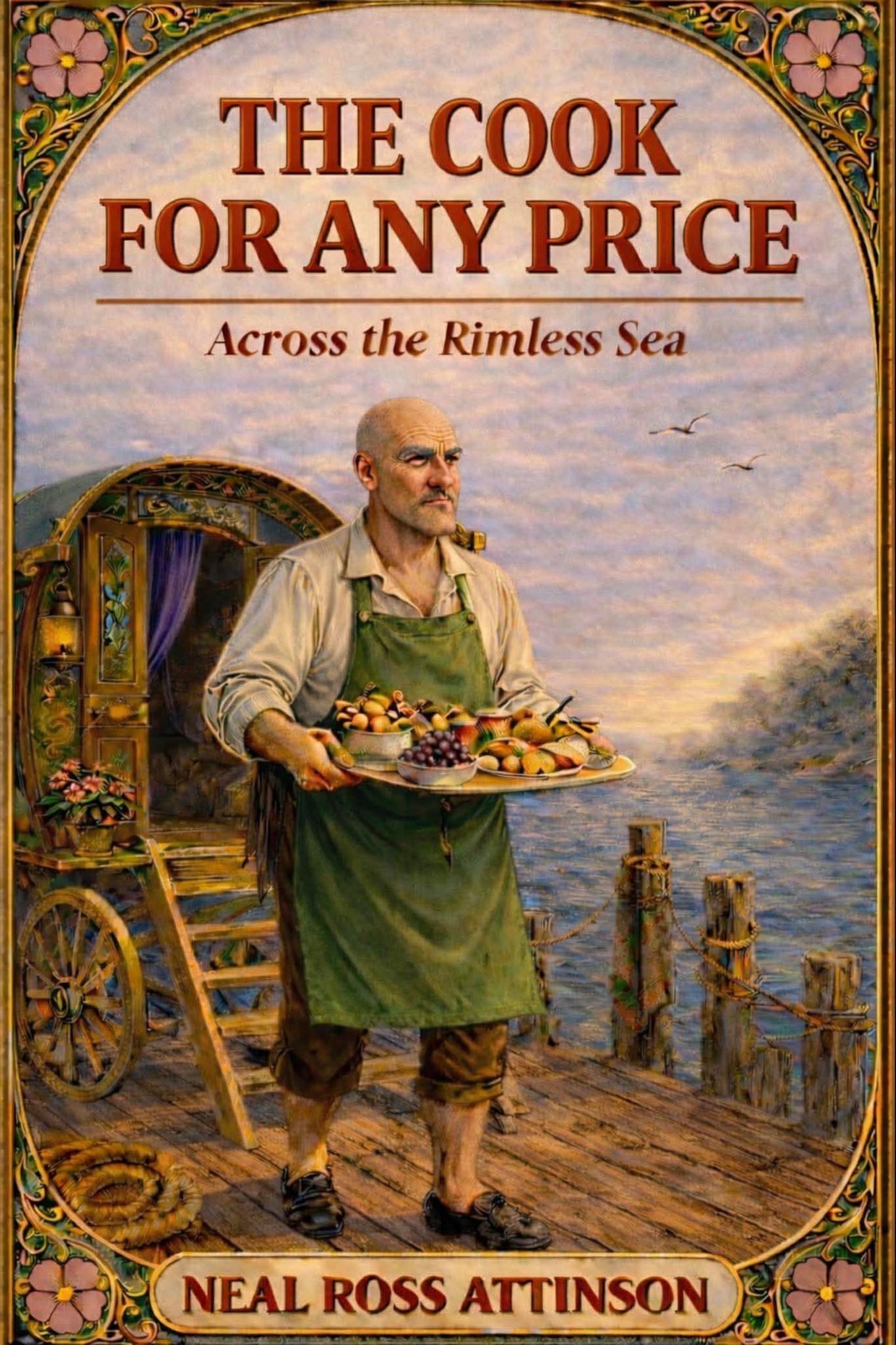
AS AN INVESTED SACREANT, Prosatio Silban ministered to the souls of the Uulian Commonwell’s faithful. But now, his mission is tending the palates and gullets he encounters in his cook-or-die quest for the next paying customer – whether demure courtesan, cranky giant, duplicitous wizard, mystical indigene, pretentious nobles, minor godling, or whoever else is hungry.

Inspired by Don Quixote, Brillat-Savarin’s The Physiology of Taste, and the Dreamlands Cycle of H.P. Lovecraft, these two volumes of episodic fantasies – The Cook For Any Price: Across the Rimless Sea and The Cook For Any Price: More Commonwell Tales – are part culinary tour and part spiritual adventure. Ride along in Prosatio Silban’s well-stocked galleywagon and through a world unlike any you’ve ever visited.

(Available through the above links as e-books, and also in paperback: Across the Rimless SeaMore Commonwell Tales!)

RECIPE COLLECTORS! Want to prepare meals (and eat!) like Prosatio Silban? The free download Commonwell Cookery will nourish appetites both gastronomic and literary. May the Flickering Gods smile upon your honest and sincere emulations.

    What Are Readers Saying?

Ransom Stephens, author of The Book of Bastards
    “Sometimes you just need to let someone else deal with the BS of life. … Prosatio Silban is the man for the job!
    “This intrepid chef travels a world that reminds you of places you’ve been, places you’d like to go, and places you’d prefer to avoid. With his old-school (really old) food truck, he achieves a view of the world (well, a world in a different time and a different place (a very different time and place)) that’s sort of like Norman Rockwell would have had, if he’d been in that very different time and place. All the while, he leaves your mouth watering with recipe ideas! Semi-seriously, it’s sort of like Patrick Rothfuss meets Julia Child. Continue reading “A Self-Defrocked Holyman In A Fantastic Land Teases Out A Meager But Honest Living As A Mercenary Cook”

Read This (E)Book

THIS IS WHAT COMES FROM puttering about in a small morning with nothing else to do (thanks, PKD, for the reference): “Little-t truths for our and every time; a considerable consideration of considerings.”

Pithyisms is, thanks to Smashwords, my second published e-book — a collection of 100+ original sayings that I have been letting drop here and there over the years. It is available in multiple formats, free of charge (at least for now), and at this writing (2105.23) is a “Featured New Release” to boot. I hope you enjoy reading it as much as I did composing it.

Metaphoraging Roundup 2020

AS THE EARTH RETURNS IN its orbit to where it was last year, here is a look at the top ten posts The Metaphorager’s readers enjoyed (I hope) during the past twelve months:

My Favorite Jewish Joke – 80 Views
As it says. I have a couple of others; but this one, with its Hidden Truth, never fails to amuse and amaze.

How To Wash The Dishes – 53 views
A discipline drawn from months and years of twice-daily practice.

365 Names of God: “The Light of Eternal Mind” – 53 Views
Non-coincidentally, my favorite line from C.B.DeM.’s The Ten Commandments. Continue reading “Metaphoraging Roundup 2020”

5 Thoughts: A Celebration of Bags

0. WHO AMONG US HAS NOT searched for the perfect shouldered carryall? Here are five of my favorites:

1. In high school, I owned a black, one-pocket, snap-closure American naval officer’s bag suitable for a notebook, pens, paperbacks and other adolescent contraband. I carried that thing around town, in caves and forests, and up hilltops and tall buildings. It finally developed more holes than I could repair, and made way for… Continue reading “5 Thoughts: A Celebration of Bags”

The Torah Guides’ Torah Guides

THE TORAH CAN BE A great read — inspiring, comforting, uplifting, provocative — but without the explanatory input of generations of commentators, it can also be a bit daunting. Fortunately, Jewish tradition has portioned this essential text into weekly bites for easier consumption. In the spirit of Simchat Torah, which begins Saturday night and marks the (at least) 2,355th end and rebeginning of the annual Torah reading cycle, here are some of the resources used by our local community over the years we’ve spent engrossed in this Book of Books.

The Sapirstein Edition: Rashi (5 volumes)
Author/Publisher: Artscroll
Slant: Very Traditional (11th to 12th Century CE)
Points: Rashi is the commentator par excellence. He is strictly concerned with elucidating the Torah’s plain meaning, and he brings to bear on each verse nearly the entire corpus of the Jewish textual tradition as it existed in his time. Use this if you want to understand Torah as Serious Jews have done for almost a thousand years. (Nice literal translation too.)
Caveats: A good deal of Rashi’s work has to do with Hebrew grammar, so keep that in mind — he can sometimes be a tad dry. Also keep in mind that he was a literalist, operating from the model that the Torah was Divinely written. Even if you don’t share that view, there’s a tremendous amount of classical Torah nutrition here. Continue reading “The Torah Guides’ Torah Guides”

5 Thoughts: Seminal v. Derivative

1. ONE OF THE CHICKEN-OR-egg challenges of modern media (social and traditional) is their pervasive sense of nonlinear immediacy, by which I mean the everything-at-once flattening of the artistic landscape.
Continue reading “5 Thoughts: Seminal v. Derivative”

Of Heroes, Waterbeds, and After-Midnight Television

THERE IS A MOVIE THAT follows the struggles inherent in the so-called Hero’s Journey: a high-born child is raised in secret by commoners, and eventually groomed by a wise elder to overcome obstacles and fulfill his destiny by taking his rightful place among the knighted nobility. And that movie is called … The Black Shield of Falworth.

If TBSoF (1954) sounds a bit like Star Wars (or even Excalibur), that’s because it travels the same mythic highway. And if it feels like 1938’s The Adventures of Robin Hood, that’s because it too was based on a Howard Pyle book, Men of Iron. Continue reading “Of Heroes, Waterbeds, and After-Midnight Television”

Fandom as Cargo Cult

IF WE BUILD IT, THEY will come — again.

First, you need to know what a “cargo cultis: a folk religion among some groups of Melanesian Islanders who believed that they could attract cargo-carrying airplanes by engaging in sympathetic magic. They got this idea during World War II, when real airplanes (both Allied and Japanese) visited these islands and airdropped actual cargoes — food, weapons, clothing, medicine, and the like. After the war, the planes stopped coming. But the islanders, convinced that the proper conditions would bring more goods, built airstrips (in some cases, complete with landing lights) and otherwise mimicked certain behaviors they thought would achieve their goals. It’s a powerful communal buzz, and easy to get lost in. Continue reading “Fandom as Cargo Cult”

First Graf: Torah

(BE HONEST — YOU MUST HAVE known I’d get around to this one eventually, right?)

I make no rigid claims of authenticity, accuracy, or authorship for this work. As far as I’m concerned, this is “simply” a collection of ancient Jewish campfire didactics which were knit together in somewhat final form some 2,500 years ago. And everything about it is open to (ideally informed) debate. That’s kind of the point, actually: to give us, and have given us, something to discuss as a community as we grope our way through the often-cruel centuries. Torah (literally, “teaching” or “instruction”) is what has kept us going for as long as we’ve been here — it ain’t the lox and bagels, folks. Continue reading “First Graf: Torah”

First Graf: The Dharma Bums

IN MANY WAYS, THIS 1958 book is better than the earlier On the Road. Kerouac’s signature stream-of-consciousness narrative style is more flowy, and the novel’s lionized centerperson (poet Gary Snyder, or “Japhy Ryder” as tDB calls him) a more noble character than OtR’s Neal Cassady — pardon me, “Dean Moriarty.” The Buddhism as portrayed is sympathetically casual without being didactic, which I suppose is also true of Buddhism itself. The book opens up in Los Angeles, where Kerouac (ahem, “Ray Smith”) is trying to “get the hell out of Dodge…” Continue reading “First Graf: The Dharma Bums”

First Graf (well, page): Harold and the Purple Crayon

THE FIRST BOOK I EVER read from cover to cover was Crockett Johnson’s 1955 work, Harold and the Purple Crayon. If you’re not familiar with it, it goes like this: A small boy in one-piece pajamas draws with, well, purple crayon, on an endless expanse of whitespace. His drawings don’t exactly come to life, but they do become interactively real (to him, anyway). The drawings are accompanied by spare but informative narration, but the real story is amply told by the charming illustrations. In all, Reb Crockett wrote seven Harold adventures; they are aimed at young would-be readers, and sort of obviate the whole Dick and Jane thing so popular when I was a tyke. Continue reading “First Graf (well, page): Harold and the Purple Crayon”

Favicon Plugin created by Jake Ruston's Wordpress Plugins - Powered by Briefcases and r4 ds card.