First Graf: The DQ of UK

THIS TITLE DOESN’T REFER TO either German nobility, soft ice cream or the British Isles, but the first paragraph (“graf” in news-speak) of one of my favorite novellae, H.P. Lovecraft‘s The Dream-Quest of Unknown Kadath. Though mostly famous for his don’t-read-at-3-a.m. Cthulhu Mythos tales, the Old Gentleman’s most lyric imagery is to be found in his stories of The Dreamlands: a sort of “collective unconscious” vaguely surrounding Earth and accessible to it at certain points. Lovecraft is often accused of unreadably purple prose; I like to think he writes more for effect than for accuracy (like a Brian Eno composition, Lovecraft’s words are best enjoyed by letting them wash over you like a salty, warm, faintly ichorous sea). Thus, and in the hopes of spreading the Old Gentleman’s visions as far and wide as possible:

THREE TIMES Randolph Carter dreamed of the marvelous city, and three times was he snatched away while still he paused on the high terrace above it. All golden and lovely it blazed in the sunset, with walls, temples, colonnades and arched bridges of veined marble, silver-basined fountains of prismatic spray in broad squares and perfumed gardens, and wide streets marching between delicate trees and blossom-laden urns and ivory statues in gleaming rows; while on steep northward slopes climbed tiers of red roofs and old peaked gables harbouring little lanes of grassy cobbles. It was a fever of the gods, a fanfare of supernal trumpets and the clash of immortal cymbals. Mystery hung about it as clouds about a fabulous unvisited mountains; and as Carter stood breathless and expectant on that balustraded parapet there swept up to him the poignancy and suspense of almost-vanished memory, the pain of lost things and the maddening need to place again what once had been an awesome and momentous place.

(Eh? EH? THAT’S what I’m talkin’ about.)

Harvey Pekar Z”TL

Fig. 1.
A MOMENT OF SILENCE WOULD be inappropriate to mark the death this morning of autobiographer, comix legend and music critic Harvey Pekar, since (depending on your view) the former Cleveland Heights resident is right now either a) arguing with “God,” b) planting one on Billie Holiday, or c) sitting around saying, “NOW what?”

Pekar’s gift for depicting the epic struggles of everyday life was mostly channeled into his comic, “American Splendor” (later a 2004 movie auteured by Paul Giamatti), itself inspired by a friendship with the young R.Crumb. His unsentimental and award-winning prose had the brutal honesty and tender insight of a Joyce or a Steinbeck, had those gentlemen worked at Cleveland’s V.A. hospital or tangled with David Letterman. Unlike many compulsive autobiographers, Harvey himself didn’t flinch from writing about his own less-than admirable side. That’s what it means to be Pekaresquely human: to accept our flaws and brokenness as the price for a wonderful sunset, cold beer, arguing with friends and everything else worthwhile on this side of the grave.

“Zecher tzaddik livracha — the memory of the righteous is a blessing.” We’re gonna miss you, Harvey. Thanks for showing us that it’s the little things that count — and that they’re not so little after all.

5 Thoughts: Fiction- v. News-Writing

1. YOU STOP WRITING A NEWS piece when you run out of facts. But when do you stop writing fiction? When you run out of story, I suppose.

2. In news, the most important information goes up top. In fiction, it’s in the reader’s head — at least with genre pieces. There has to be some connection between the reader’s mind and the writer’s expression in terms of shared assumptions or expectations. A science fiction author knows his readers are unfazed by three-headed alien bankers, so doesn’t need to waste valuable real estate on justifying same beyond adhering to strict internal consistency. Someone writing for a general audience needs to adjust their bankers, but touch not the consistency! Continue reading “5 Thoughts: Fiction- v. News-Writing”

Jon Stewart Slams Glenn Beck Idol

THE DEMISE OF THE HEADLINE-WRITER’S art (according to a recent article fed through both Slashdot and The Daily Beast) dictates an appeal to search engine optimization (SEO) instead of readers — something that snags on Google instead of anticipatory imagination. Thus, the perfect SEO headline for anything would be the above, as it’s (quoting from memory since I can’t find the original article, alas) “guaranteed to bring in thousands of page hits.” (I added “Idol” just to tweak the numbers, in my own special pundit Beltway Comedy Central Lady Gaga Obama porn Mafia Wars Stephen Colbert Go USA way.)

So there we go. I’ll post an update in 24 hours (hmm… better make it 36) and see how many Fabulous Prizes and Destination Sunsets we’ve won. (So to speak. Heh heh heh.)

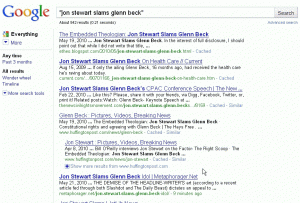
UPDATE: JSSGBI+10 minutes: THIS is CREEPY. As in OMG!!! creepy. I no sooner post this when, touched by curiosity, I Google “Jon Stewart Slams Glenn Beck.” And:

The mind-blowing evidence of Google's unholy grasp on the world's electronic tentacles.
Fig. 1.

NUMBER FIVE??? IN N*I*N*E M*I*N*U*T*E*S?!?!?!?!? That’s actually pretty cool…

See, This Is Why I Love Jack Vance

IT’S NOT THAT HE RENDERS whole worlds so vividly and so succinctly, peopling vast and history-thick galaxies with one or two spare sentences.

It’s not the cinematic sweep of his prose, which respects his readers’ visual imagination by meeting it halfway; the mad genius of his invention, which conjures up aliens both A*L*I*E*N and logical in the extreme — as well as their customs, currency and literature; nor his subtle command of language and love thereof, of its effect on the listener’s ear as well as his intellect, of conversations as oblique as they are elegant.

Actually, it is all of the above, and more, but what I love most about Jack Vance is his laconic sense of perspective. E.g., from page 65 of the Ace Double edition of The Houses of Iszm, where one character consoles another against the world’s unfairness:

The Szecr sub-commandant twirled his viewer. “The Universe is eight billion years old, the last two billion of which have produced intelligent life. During this time not one hour of absolute equity has prevailed. It should be no surprise to find this basic condition applying to your personal affairs.”

(P. S.: Dying Earth is great, too.)

Journalism As Art Imitating Life

CAN WRITERS REPORT? THAT QUESTION nets a “yes” according to Daniel Elstrin in the June 19 Forward, reporting on the day Haaretz (think Israeli NYT) swapped its staff for 31 leading authors and poets:

“Among those articles were gems like the stock market summary, by author Avri Herling. It went like this: ‘Everything’s okay. Everything’s like usual. Yesterday trading ended. Everything’s okay. The economists went to their homes, the laundry is drying on the lines, dinners are waiting in place… Dow Jones traded steadily and closed with 8,761 points, Nasdaq added 0.9% to a level of 1,860 points…. The guy from the shakshuka [an Israeli egg-and-tomato dish] shop raised his prices again….’ […]

“News junkies might call this a postmodern farce, but considering that the stock market won’t be soaring anytime soon, and that ‘hot’ is really the only weather forecast there is during Israeli summers, who’s to say these articles aren’t factual?”

This is also the sort of newspaper dreamed of by most, if not all, of my reporterly colleagues, at least at some time or other (usually on deadline day of a slow week). But that’s true in another, non-ironic way: Elstrin also cites a couple of features whose subtle depth make a nice model for would-be human chroniclers.

Peruse:
Daniel Elstrin’s article
Ha’aretz Archives; select “10 jun” from the “Previous Edition” menu at lower left.

Happy Bloomsday!

105 YEARS AGO TODAY, LEO Bloom took his famous fictive walk through Dublin seeing the same places and eating the same foods as his latterday followers did, will do or have done today. (Me, I’ll be sitting on the floor with Ulysses and crying in my (virtual) Guinness over my small literary pretenses. Joyce uses the same words as the rest of us (okay, he also invented some, but still) — how does he manage to arrange them so? It’s just not fair, but so is Molly, yes she is yes.)

Read This Book

THERE IS A Conversation THAT I’ve been having with a friend since we were both in high school, and the initial-cap in that word is due not to the colloquy’s duration but to its content.

Its thesis is simple: that Something Connects All This. Being a spiritual sort of guy, I feel more comfortable describing It in terms not far removed from the religious. Not so my erstwhile colleague and former brother-in-law Ransom Stephens. Ransom’s a physicist by inclination and training — passionately curious about why and how the universe works the way it does — and though we long ago realized that our different takes on the Ultimate Essence stemmed from a subject-not-Object orientation, we’ve never let that get in the way of a good 3 a.m. walk-and-talk.

Not surprisingly, his first novel — The God Patent — deals with those exact issues. As Ransom describes it: “A laid-off engineer trying to rebuild his life gets caught between science and religion in a battle over the origin of the universe and the existence of the soul.” TGP is one of the featured titles on Scribd.com, and clicking on the above link will not only help support a rising Northern California writer but will make it easier for all of those with a book or two in us. Check it out, and tell ’em Neal sent you.

Re-Re-RE-Reads

SOME BOOKS ARE FINISHED IN a day; others, only when we are.

If books are portable doorways, then stepping into a beloved-since-childhood instant Now every few years can sometimes tell us where we’ve been in the meanwhile. As one of my perennial obsessions is the slippery intersection of awareness and time — e.g., free will[1] as side effect of fore-ignorance[2] — many of my own favored rereads tend to be “quest” stories: people who go in search of something and discover something unimaginably else. Here are five or six:

» Lord of the Rings (trilogy), J. R. R. Tolkien
If you’ve seen the movie, you think you know the story. But if you haven’t read the books, you really really don’t. Tolkien’s words have a different flavor in the mouth than on the page; I recommend reading these aloud, one night at a time, to someone you enjoy. (Takes about a year.) If you can do voice impressions, so much the better.

» The Stars My Destination, Alfred Bester
Space-stranded Gully Foyle was waiting to die until a passing ship ignored his pleas for rescue. His vengeance takes him from the interplanetary gutter to the height of decadent society, but his education elevates him to the next phase of human potential.

» Alice’s Adventures in Wonderland and Through the Looking-glass, Lewis Carroll
A chief delight of my 40 years’ acquaintance with Carroll’s endless puzzle has been watching it slowly transform from fairy tale to divine satire. How does he do that?

» Schrodinger’s Cat (trilogy), Robert Anton Wilson
Extrauniversal intrigue among at least three universes next door to this one, all wrapped in a literary Moebius strip. Wilson once offered a quick intelligence test: If the universe is getting bigger and funnier, you’re getting smarter. RAW’s books are for anyone who wants to become smarter — and really, shouldn’t that be everyone?

[1] For the record, I am not smart enough to reckon the “difference” between “free will” and “predestination.” However, I’m fairly sure that it’s my hand — and not God‘s — who’s picking out my socks and entertainment, at least most of the time.

[2] Similar to, but more certain than, “foreknowledge.”

Favicon Plugin created by Jake Ruston's Wordpress Plugins - Powered by Briefcases and r4 ds card.