Where Do The Ideas Come From?

LET’S MAKE THIS AN EXPLORATION of the landscapes of creativity — how does the creative experience feel to you?

Mentally, I’m all about visualization: perhaps it’s synesthesia, but even smells and sounds have a visual component for me. So I’ve always seen “the creative process” as starting with a curtain across half the universe. Every now and then, the curtain parts just enough to reveal an Idea.

It could be a series of images, even images of words. Now and then it’s a sound. But even the most abstract Idea carries a visual impression of girders and joists, ropes and scrim. Sometimes an Idea will be revealed a piece at a time, with a whole clicking into place almost audibly and palpably. If it’s long, like a story, it feels like a rope uncoiling from the other side of the curtain — a line which must not be allowed to grow slack.

Sometimes an Idea links up with something inside the rest of the universe. Other times it just sits there, gleaming, faintly pulsing, daring me to capture it in words on a screen or a sketch in a notebook. (If I don’t, it can fade within minutes.)

So let’s make this an exploration of the sense-scapes of creativity. How does the creative experience feel to you?

Big Room, Little Box

SO NASA HAS JUST RELEASED a nifty web application that lets you whiz about the solar system in real time and swoop in next to planets and satellites and space probes to see what they’re doing (or at least what the programmers know that the scientists know that they’re doing). It’s called, appropriately, “Eyes On The Solar System” and if you don’t click on http://solarsystem.nasa.gov/eyes/ RIGHT NOW and try it boy will YOU be sorry. (Between this, Google Earth and Minecraft, the inner and outer worlds should mesh any day now.)

First Graf: The Lore Of Sail

THE MARITIME SECTION OF MY home library is, like a captain’s yacht, small but well-appointed. I’ve been a ship geek since 1987-88, when I served as a deckhand/docent on a replica of the Golden Hinde, and my taste tends toward the practical: knots, rules of the road, sea survival, Bluejackets’ Manual, even a 1955 Watch Officer’s Guide published at Annapolis. One book whose slim size belies its comprehensivity is more theoretical and historical: I refer to the excellent 1982 volume The Lore Of Sail.

LoS’ 256 pages are divided into four sections plus index: The Hull, Spars and Rigging, The Sail, and Navigation and Ship-handling. Each is a well-illustrated guide to the historical evolution of ships from ancient Egypt to modern Europe. Its size makes it perfect for backpack or peacoat pocket while browsing the world’s great maritime museums or rigged ships, but it’s also museum-like in scope and scale. From the Introduction by Captain Sam Svensson:

From ancient times, sailing the seas has been a unique profession, with techniques and methods which have always puzzled the landlubber. One thousand years before Christ, Solomon said that the way of a ship in the midst of the sea was too wonderful for him to understand.

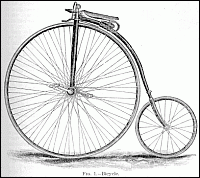
Bicycle Safety 101

THERE IS ONE INFLEXIBLE RULE which, if followed diligently, will result in years if not decades of safe bicycling: Pretend you’re invisible.

Now, many get the wrong impression on first hearing this advice — they hear “invisible” and think “invincible,” as if an inability to be seen were some sort of safety asset. As a former bike messenger and longtime bike enthusiast, it’s been my observation that many drivers either can’t or won’t see you — especially in city conditions. And that can be … problematic. Continue reading “Bicycle Safety 101”

Gritty Comfortoir

AND AFTER ALL IS SAID and done, and the horrible truth revealed
The bodies taken away, the last question answered
Comes William S Burroughs
(the gravelly graandpa who’s done things the grownups won’t let you ask him about).
“Interdimensional Alka Seltzer,” he says, proffering a grey fizzing mug,
and sits down beside you.
You take the cup.
He speaks volumes with his eyes
(they’ve seen it all, long before you were born)
but his mouth only says
what you wish it always wouldn’t:
“That’s just the way it is, Out Here.”

Who Is This Prosatio Silban, And What Does He Want?

Prosatio Silban in his galleywagon / Illo (c) 2008 Alana Dill, http://youbecomeart.com
IN NORTHERN CALIFORNIA’S DIABLO VALLEY c. 1978, Dungeons & Dragons was barely known outside the fantasy-and-science-fiction community. I first learned of it around that time via David Hargrave‘s Arduin: a created world not unlike J.R.R. Tolkien’s Middle Earth, C.S. Lewis’ Narnia, or Fritz Leiber’s Lankhmar.

The most addicting D&D element for me has always been “worldbuilding” – establishing an ecology of people, monsters and treasure within a self-consistent storytelling framework. It’s an excellent outlet for structured creativity, and one day, while at my day-job as an offset printer, I grabbed a pad, scrawled a coastline and bay, added some mountains and a river basin, and began describing those who lived there.

Some years later I had compiled several notebooks and folders full of maps and diagrams, charts and lists, races and religions, legends and monsters, mostly written in two-to-60 minute slices during and between offset jobs. It was a lot of fun. But it was also pretty lonely; at that point, I didn’t play D&D anymore, and I felt a bit … unrequited. And, to be honest, somewhat silly.

The Exilic Lands and environs

So in 2005, I decided to tell stories to answer the question, “What would it be like to actually make a living in one of these invented worlds?” After all, somebody has to clean up all those slain dragons (and, probably, buy groceries and pay rent). Thus was born Prosatio Silban, self-defrocked holyman and mercenary cook.

Worldbuilding and its fruits have brought me great joy (and occasional comfort) during the past several decades. I hope you have found some joy in it too.

When The Troll Sweats, Bottle It

Fig. 1.
IN THE STARS MY DESTINATION, Alfred Bester imagines a world peopled (in part) by a cast-off group of future savages who chant scientific formulae during their religious rituals. “Quant Suff!” they chant, in abbreviated imitation of “sufficient quantity.” “Quant Suff!”

At the Renaissance Pleasure Faire, I inhabited a world peopled (in part) by a cast-off group of fannish folk who sometimes chant together after consuming a quasi-alchemic formula during their quasi-religious rituals. “Trolle Sweate!” they chant, in inebriated consequence of quant suff. “Trolle Sweate!”
Continue reading “When The Troll Sweats, Bottle It”

5 Thoughts: How To Lead Services

0. THE FOLLOWING MAY BE PARTICULAR to Jewish worship services, which are the only sort I’ve led (not counting five weddings and various improvised blessings/moment-summonings). But I’ve tried to adapt the advice for anyone whose worship tradition includes structure and text, and who finds oneself in the liturgical spotlight. Hope it helps; I learned it all the hard way.

1. Know your material. This may sound fairly obvious, but I mean it in a deeper sense: The service-as-conducted is a living breathing entity whose skeleton is the service-as-written. Know the latter like you know your own breathing. At least know how and why it’s structured — what each piece hopes to achieve, and how it leads to the next — and, most importantly, what page everything’s on. (PostIts are a big help here, as is having your own siddur (prayerbook) to notate.) Likewise, see in advance to the functioning of candles, wine, microphones, guitar strings, etc.; there’s nothing like a last-minute surprise on a solemn occasion (ah, but see thought #4). (And if you’re feeling terribly insecure, keep in mind that for group readings you really only need to emphasize the first five words. It takes that long for people to catch on and start drowning you out.)
Continue reading “5 Thoughts: How To Lead Services”

Favicon Plugin created by Jake Ruston's Wordpress Plugins - Powered by Briefcases and r4 ds card.