 REMEMBER THE WHOLE EARTH CATALOGS? Mostly subtitled “Access to Tools,” they were popular mainstays of the late 1960s-1970s’ DIY culture, spanning a variety of subjects from computers to home gardens. One of them, 1989’s Fringes of Reason: A Field Guide to New Age Frontiers, Unusual Beliefs and Eccentric Sciences, deserves a place on the bookshelf of any student of the more outre reaches of the human condition, right along with Charles Mackay’s Extraordinary Popular Delusions and the Madness of Crowds or The Books of Charles Fort (both of which are covered in detail — as is The Book of the SubGenius). Continue reading “First Graf: Fringes of Reason”
Tag: First Graf
Sometimes a great book reveals itself in the opening paragraph (“graf” in reporter-speak). Here are some of my favorites.
First Graf: An Everlasting Meal
 THIS IS THE BOOK THAT inspired me to cook for myself. It demystified for me the cooking process, shored up my nascent resolve, and gave me the mental tools I needed to commit the revolutionary act of not settling for or eating processed food anymore (aside from cheese, bread, and other fermented eatables, of course). It also contains, as Chapter 12, the greatest food essay ever written, which — as I have noted elseblog — adjures you to call upon your inner chef to arise when you’re sick of cooking. (No mean feat, that.) Continue reading “First Graf: An Everlasting Meal”
First Graf: The Gourmet’s Lexicon
 SITTING ON MY BOOKSHELF IS a slim purple volume from 1982 called The Gourmet’s Lexicon, an encyclopedic and indispensable listing of cuisines, dishes, and cooking techniques and styles. What Webster was to words, author Norman Kolpas is to food. Often I will leaf through it at random, trying to expand my cookery-consciousness; other times I will use it to look up something I see mentioned in a recipe or on a cooking documentary. (I’ve even used it as a basis for a few Prosatio Silban tales.) Whatever the need or occasion, it’s a fine ingredient in any cook’s or foodie’s library. Continue reading “First Graf: The Gourmet’s Lexicon”
First Graf: The Jewish Catalog

As the subtitle implies, the book is chock-full of homemade ways to “do Jewish,” from making your own challah, tying and laying tefillin, navigating a siddur (prayerbook) or the Torah, burying someone with dignity, mystically understanding Shabbat, navigating the “Jewish Establishment” and much much more. Published in 1973 (and serially reprinted since then), it spoke to the nascent anti-authoritarian paradigm of “ethnic pride” and “finding your roots” that was then sweeping the United States. It features articles from such luminaries as Rabbi Zalman Schachter (founder of the Jewish Renewal movement) to Holocaust scholar Deborah Lipstadt, and sparked a communal yearning for authenticity and connectedness that still resonates today. The lavishly illustrated book spawned two sequels and is still relevant to anyone seeking to jump into the sea of Judaism: Continue reading “First Graf: The Jewish Catalog”
First Graf(s): The Book of the SubGenius
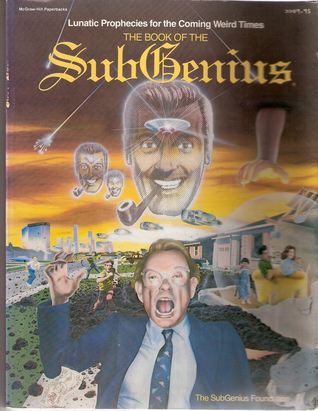 THIS BOOK SAVED MY LIFE. Well, not the book per se — although that definitely helped — but one of the guys who wrote it. The Book of the SubGenius told me that there were Others Out There who felt and thought as I did (or as differently as I did), and when I went through a suicidal phase back in ’85 I wrote to co-author Ivan Stang explaining my position. He immediately wrote back a two-page letter asking me not to do it and saying that if nothing else, I could always live for spite — that living could be a sort of revenge against the multiform factors contributing to my wanting to off myself.
Dang if he wasn’t right. Continue reading “First Graf(s): The Book of the SubGenius”
First Graf: The Illuminati Papers
 THE LATE ROBERT ANTON WILSON is perhaps the greatest influence on my life and thought since even before Rabbi Akiva. His spirit is sprinkled here and there throughout this blog like raisins in a cake. A prolific author, RAW (as he’s known) wore many literary caps: conspiracy chaser, little-L libertarian, mind-expansionist, novelist, futurist, comedian, neophile, mystic, poet, prophet. Continue reading “First Graf: The Illuminati Papers”
First Graf(s): The Book of the Damned
First Graf: Path of the Just
MUSSAR (מוסר) IS A HEBREW TERM usually translated as “ethical behavior/discipline,” or to put it more succinctly, the fine art and science of being a mensch. Its roots are almost as old as Judaism itself — according to Genesius, it’s mentioned about a dozen times in the Tanakh (the Hebrew Bible) — but the so-called “Mussar Movement” (people gathering together to help each other become better people) first flourished in the 19th century, largely among the Orthodox Jews of Lithuania. It has undergone a renaissance of late, and several of the Mussar classics are available today. One such book is The Path of the Just (Mesillat Yesharim). Written in the 18th century by Rabbi Moshe Chayim Luzzato (“Ramchal”), it takes the reader through a step-by-step interpretation of Mussar traits as listed in the Talmud. R’ Luzzato begins his work in typically humble style, apparently siding with Ecclesiastes that there’s “no new thing under the sun”: Continue reading “First Graf: Path of the Just”
First Graf: Silverlock
TAKE PILGRIM’S PROGRESS, STAR A grumpy Chicagoan, people the landscape with characters and places from the world’s literature and you have Silverlock — a fable of the human spirit no less great or more complex a story than a man discovering the world of letters and how it changes him. I have read it twice now, once from the depths of a great spiritual crisis, and the effect is almost electric. Half the fun is spotting the references; another half is author John Myers Myers’ love of language; a third half is how it makes you feel. Silverlock may or may not change your life, but it will certainly change your view of storytelling — and isn’t that sometimes the same thing?
If I had cared to live, I would have died.
A storm had come up. While not sick, I found my bunk the most comfortable place, leaving it only to take my meals. Dozing after supper, I learned of disaster when a wave bashed in the door of my deck cabin. The backwash sluiced me out of it and stranded me by a stowage locker.
First Graf: Zen and the Art of the Internet
THE FIRST BOOK I EVER read about the Internet, in 1994, still gives me a wave of nostalgic novelty when I turn its pages now. The ‘Net was new in the public mind and not well understood back then, which is why books like 1992’s ZATAOTI were popular: it’s a beginner’s guide to all things then-Internet, from email to the Electronic Frontier Foundation.
These days, you just Google to find anything. But before Google (and before the World Wide Web) were Usenet and FTP, telnet and Gopher. You sort of had to know your way around in order to find anything. ZATAOTI’s 95 pages helped make the learning curve less steep for millions of people by helping them to think clearly and concisely about this strange new technology.
The composition of this booklet was originally started because the Computer Science department at Widener University was in desperate need of documentation describing the capabilities of this “great new Internet link” we obtained.
It’s since grown into an effort to acquaint the reader with much of what’s currently available over the Internet. Aimed at the novice user, it attempts to remain operating system “neutral”—-little information herein is specific to Unix, VMS, or any other environment. This booklet will, hopefully, be usable by nearly anyone.
First Graf: The Lore Of Sail
 THE MARITIME SECTION OF MY home library is, like a captain’s yacht, small but well-appointed. I’ve been a ship geek since 1987-88, when I served as a deckhand/docent on a replica of the Golden Hinde, and my taste tends toward the practical: knots, rules of the road, sea survival, Bluejackets’ Manual, even a 1955 Watch Officer’s Guide published at Annapolis. One book whose slim size belies its comprehensivity is more theoretical and historical: I refer to the excellent 1982 volume The Lore Of Sail.
LoS’ 256 pages are divided into four sections plus index: The Hull, Spars and Rigging, The Sail, and Navigation and Ship-handling. Each is a well-illustrated guide to the historical evolution of ships from ancient Egypt to modern Europe. Its size makes it perfect for backpack or peacoat pocket while browsing the world’s great maritime museums or rigged ships, but it’s also museum-like in scope and scale. From the Introduction by Captain Sam Svensson:
From ancient times, sailing the seas has been a unique profession, with techniques and methods which have always puzzled the landlubber. One thousand years before Christ, Solomon said that the way of a ship in the midst of the sea was too wonderful for him to understand.
First Graf: The Science Fiction Hall of Fame, Vol. 1
THERE ARE BOOKS, AND THERE are books. This one contains “The Greatest Science Fiction Stories of All Time Chosen by the Members of the Science Fiction Writers of America,” and is standard issue to all geeks and geekettes who want to know the first thing about things SFnal. (It’s subtitled “Volume One, 1929-1964;” Volume Two (which I haven’t read) is itself two 1973 volumes devoted to novellas written and published between 1895 and 1961.)
I first read this (these? it’s an anthology, after all) when I was eight years old, as part of the first package I ever got from the Science Fiction Book Club. Without it for years, I now have a spiffy new trade paperback which seems almost a facsimile of the original contents in terms of fonts, layout, etc. And the memories! Stuck in Fredric Brown’s alien showdown (which became a Star Trek episode)! Trapped with Lewis Padgett’s mad teaching machines! Exploring Tibetan mythology with Arthur C. Clarke!
Continue reading “First Graf: The Science Fiction Hall of Fame, Vol. 1”