 IT’S FALLING ASLEEP HOLDING A copy of Herodotus’ The Histories or Gaster’s The Oldest Stories in the World. It’s the endless theorizing about daily life in a different context. It’s the observation that no matter what the era, people will still be people. It’s the seminal technologies still strangely similar to our own. (It’s thus the feeling of anthropological deja vu.) It’s the skill and effort involved in translations. It’s the feeling of Deep Time, even though recorded history is only 6,000 years long. (It’s also knowing that we’ve only had 200-300 generations in that time.) Continue reading “Why I Love: Ancient History”
Tag: Committee For A Bigger Universe
Transcendent Science and Knowery.
First Graf(s): The New Hacker’s Dictionary
 THE DEFINITION OF “HACKER” HEREIN is “a person who enjoys exploring the details of programmable systems and how to stretch their capabilities, as opposed to most users, who prefer to learn only the minimum necessary.” In 2019, we have all sorts of hackers — computer hackers, life hackers, biohackers, mindhackers — all trying to understand, implement, and twiddle with hidden qualities and little-known or -understood features of whatever it is they’re hacking.
The New Hacker’s Dictionary, adapted from and AKA “The Jargon File,” got its start in 1975 as a text file (accessible by what your Grandpa used to call “FTP“) shared over networks by the original (computer) hackers. Continue reading “First Graf(s): The New Hacker’s Dictionary”
Truth v. Lies
SOME TIME AGO, I HAD a Facebook encounter with a dear friend who’s something of an Evangelical Atheist. It all started when another dear friend posted the following “meme” to my “wall:”
OMNISM: THE BELIEF THAT NO RELIGION IS THE ONLY TRUTH, BUT THAT TRUTHS ARE FOUND IN THEM ALL.
To which my atheist friend replied:
Alas, some lies, too. And little explanation of how to sift one from the other.
First Graf: The Timetables of History
 AN AWE-INSPIRING WORK, The Timetables of History: A Horizontal Linkage of People and Events by Bernard Grun is one of those books that have to be seen, and leafed through, to believe. (My own copy, of the 591-page edition First Touchstone Edition which begins at 5000-4001 BCE, only goes up to 1978 CE; revised editions are available through your local independent bookstore.) As the title states, Timetables proffers to the curious what happened in each year (or, in the book’s early parts, each date1-to-date2 era) in seven categories: History and Politics, Literature and Theater, Religion and Philosophy, Visual Arts, Music, Science and Technology, and Daily Life. Continue reading “First Graf: The Timetables of History”
The #popscope Phenomenon
 AFTER I BOUGHT MY OWN telescope (an Orion StarMax 90mm Maksutov-Cassegrain with equatorial mount), I would take it out in the early evenings on the sidewalk in front of our building with a sign leaning against the tripod that read, “FREE MOON TRIPS!” If anyone happened by (as they often did,) I would ask them, “Would you like to see the Moon?” Almost everyone did, and I took great pleasure in their gasps of awe as they saw up-close lunar craters for perhaps the first time.
Something of the same spirit infuses the nascent #popscope movement. Continue reading “The #popscope Phenomenon”
5 Thoughts: The ORIGINAL Matrix
 1. WHILE I DON’T BEGRUDGE THE siblings Wachowski their success, and I don’t really believe they stole my idea, as the first populizer of something called “The Matrix” I feel I must firmly and finally speak my piece.
2. Make a circle with a dot in the center. The dot represents you. Within the circle is the sum of your knowledge. Outside the circle is the vasty unknown. The circle itself? I call that The Matrix.
3. This simple reality-diagram was created by me c. 1990, long before the first installment of the popular film series, as part of the work I did for Obscure Research Labs. Continue reading “5 Thoughts: The ORIGINAL Matrix”
Why I Love: Travel
IT’S THE NOVELTY. IT”S TRYING to see new places through the eyes of their long-time residents. It’s the road-trip soundtrack, whether CDs, tapes or new-to-me radio stations. If flying, it’s seeing the landscape from a different perspective; it’s the tiny bottles; it’s the in-flight magazines and audio offerings (and it was eating the twice-wrapped kosher meal, at least when airlines still offered meals). It’s watching urban areas dissolve into countryside the further away you get from the city. It’s finding new places to eat, and eating like the locals. It’s testing the limits of my comfort zone. It’s the packing. (It’s also the unpacking.) Continue reading “Why I Love: Travel”
First Graf: Fringes of Reason
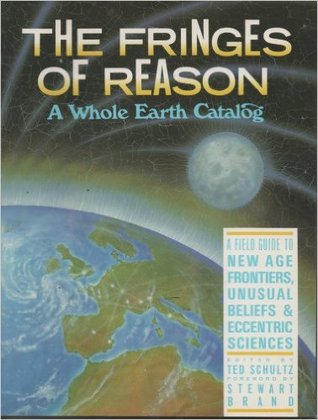 REMEMBER THE WHOLE EARTH CATALOGS? Mostly subtitled “Access to Tools,” they were popular mainstays of the late 1960s-1970s’ DIY culture, spanning a variety of subjects from computers to home gardens. One of them, 1989’s Fringes of Reason: A Field Guide to New Age Frontiers, Unusual Beliefs and Eccentric Sciences, deserves a place on the bookshelf of any student of the more outre reaches of the human condition, right along with Charles Mackay’s Extraordinary Popular Delusions and the Madness of Crowds or The Books of Charles Fort (both of which are covered in detail — as is The Book of the SubGenius). Continue reading “First Graf: Fringes of Reason”
You Too Can Be a Citizen Scientist!
 IT’S CALLED ZOONIVERSE — AND IT’S revolutionizing science as we know it.
Modern scientists (like the rest of us) live in an age of Big Data: zillions and zillions of units of information, too many for one person to effectively process. Enter Zooniverse, which for the past several years has been dragooning legions of interested volunteers to sift through hundreds of data-dumps in order to match patterns that a computer can’t — classifying galaxies, say, or rain-forest flowers, or a British census, or Beluga whales, or African wildlife, or other projects in such fields as climate science, history, biology, medicine, the arts, language and many more. Continue reading “You Too Can Be a Citizen Scientist!”
Preach it, Isaac.
Anti-intellectualism has been a constant thread winding its way through our political and cultural life, nurtured by the false notion that democracy means that ‘my ignorance is just as good as your knowledge.’”
― Isaac Asimov
Why I Love: Geology
IT’S THE SMELL OF THE rocks. It’s knowing what everything on the surface is sitting on. It’s the finding of hand-samples. (It’s also the finding of fossils.) It’s the divisions of igneous, sedimentary and metamorphic. It’s the appreciation of Deep Time. It’s the walking-about in nature. It’s that every rocky layer is a page in a vast book. It’s the feel of obsidian and chert and soapstone. It’s knowing the Mohs scale. It’s using the Mohs scale. It’s that the raw ingredients are made out of stardust. It’s literally seeing the connection-to-everything-else. Continue reading “Why I Love: Geology”
Well, That Settles That
All opinions are not equal. Some are a very great deal more robust, sophisticated and well-supported in logic and argument than others.”
~ Douglas Adams